Predictability, explained so your grandma would understand
Lets make it crystal-clear once and for all
published 12 October 2026
Imagine your typical grandma, sitting cosy in her rocking chair, knitting you a sweater. Except for Sundays, when you visit and your kids won’t give her a second’s rest, her life is built around routines, one of them being the knitting. She’s been doing it as long as you can remember, and you are the kind of family that loves those knitted sweaters, so by now she’s knitted a whole three generations of the woolly things. To you and your family they are almost like pets, and the ones that are worn beyond repair are buried in the back of the garden, their resting places mingling with the graves of two cats and the pet otter that got run-over last summer.
Ask your grandmother how long it takes to knit a sweater, and she will happily give you an estimate. In weeks if not in days:
“Ooooh, how lovely of you to ask, my dear child. If your father only knew, my mind is not what it used to be but let me see, let me see, I have this beautiful colour that I’ve been dying to work with, and I think it would fit perfectly with your eyes. I need to finish this one for Iris first, but after that, I could have yours ready right for your birthday!”
If you were to ask her how long it took her to knit the various sweaters your family owns, she would probably get into a rambling reminiscing about each sweater, going into the details of how the wool felt, how the patterns each offered their own challenges, how the receiver received it, and how that very big sweater for your uncle took ages to make.
After a slow, rainy afternoon with multiple cups of tea, you might end up with data for say 200 sweaters. If you were to plot the number of sweaters that took a given number of days to make, you might end up with a graph similar to this one:
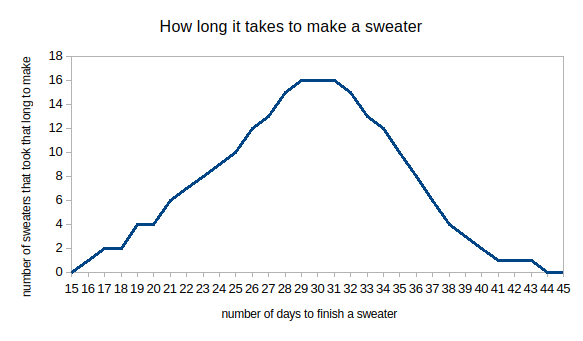
I’m sure this graph looks pretty familiar to most of you, and it should, because this is the very famous and well known bell curve, upon which modern statistical theory is built. It shows the average time it takes to make a sweater (30 days), and how the chance that it will take longer or shorter to make a sweater gets smaller and smaller the farther away you move from the average. It is also called the Gaussian distribution, or Normal distribution, and was discovered by Carl Friedrich Gauss back in the 19th century. Or maybe in the 18th century by some French mathematician, but for this story, that is neither here nor there.
The important thing is that with a bell curve, the farther you move away from the average, the more improbable an event becomes. You can see that of the 200 sweaters, only 2 were delivered in 17 days. So the probability of a sweater taking 17 days is 2 divided by 200 which is 1%. So only one sweater in a 100 will take 17 days.
And you can add these probabilities up. So for example, by adding up the number of sweaters that took longer than 35 days (8 + 6 + 4 + 3 + 2 + 1 + 1 + 1 = 26), you can calculate that the probability of a sweater taking longer than 35 days is 13%. Out of each 100 sweaters made, 13 will take longer than 35 days.
Awesome! A tool to make predictions and understand the chances of the prediction actually coming true! In your face, Nostradamus! This is such a powerful tool that it is one of the foundations of our modern world. Everyone uses it, scientists, economists, bankers, casinos, insurance companies.
In a factory, production is measured using this same idea. Variations in delivery time, quality, efficiency, safety and maintenance are introduced into the system by small mistakes made in the production process, and this creates bell curves, which can then be used to help factory managers to figure out how to reduce those variations. This is what Lean is all about.
Six Sigma takes this to a higher level, in which the goal is to reduce variations to extreme levels in terms of a bell curve. Imagine a factory that manufactures medical syringes. To receive an ISO Quality Certification, the inner diameter of the syringe must be incredibly precise so the plunger fits perfectly. And this is communicated in terms of an ideal diameter of 10.00 millimeters, with an acceptable variation of 9.94 millimeters and 10.06 millimeters.
When things get complex
Going back to your grandma, let’s imagine she gives you a call. She’s very excited to tell you she has joined a knitting club! And it is not just any knitting club, they have won awards and often get invited to fairs and conferences. Woohoooo!
You are happy for her and don’t think much more of it. But as the weeks and months pass, you start noticing that the sweater predictability is off. Way off. You notice the time it takes to make a sweater is getting longer and longer. The last one, which was supposed to be ready for your aunt’s birthday, was finished two weeks after your aunt’s birthday. And for the first time ever, you actually ended up having to chase grandma to get it finished.
There are exceptions. Like the three sweaters that were taken up as a project by the knitting club, and got delivered in an unheard of 5 days. Even 0 days seems achievable, if you count the 9 sweaters the club knitted for a fundraiser and grandma distributed among very pleased family members.
Beyond the sweater predictability, other things seem to be changing too. Last Sunday you drove over for your weekly grandma visit and she wasn’t home! In fact, her old routines, which made her life so utterly predictable, seem to be lost, and you no longer have a reliable grip on her life. It’s gotten to the point that you literally have to call her to check whether she is home. Inconceivable!
After months of dealing with these changes, redrawing graphs that are totally useless, you finally come to accept that the old sweater bell curve has ceased to exist. It is simply impossible to make sense of when you might get a sweater.
And that my friends, is the scary world of complexity. As opposed to a complicated world, where things are often stable and tend to balance out into something, well, predictable, in a complex world things are changing all the time and these changes can have a huge effect, driving results all over the place.
So, before the knitting club, your grandma did all kinds of things that had an effect on her knitting, but the effect was minimal, because they were all small things, with a small effect. That was the complicated (or perhaps even simple) world. But once she joined the knitting club, that turned out to be a very big thing affecting her life, and everything went haywire.
Our Need for Certainty
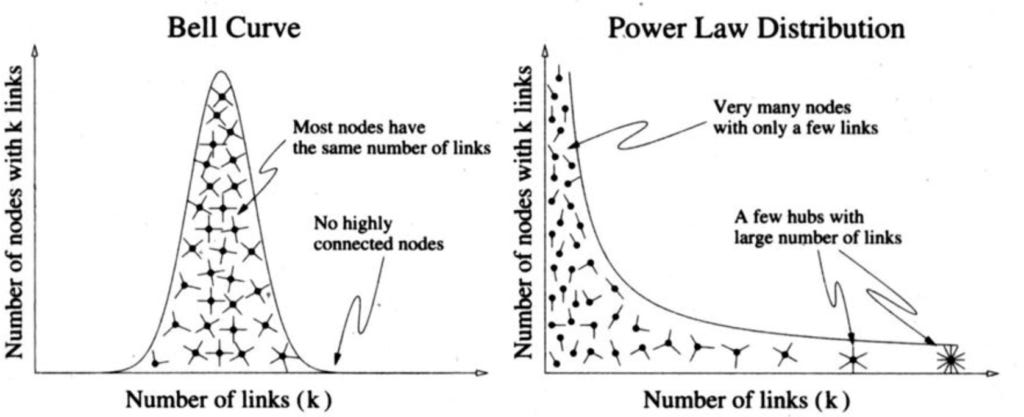
We human beings are obsessed with being able to predict things and control them. It is part of our nature, and something we have a hard time letting go of. The temptation to stick the bell curve perspective on the world is huge, and people do it all the time, even for things that are obviously, blatantly unpredictable.
Don’t believe me? The single most catastrophic, multi-trillion-dollar example of this mistake is the 2008 financial crisis. Economists assumed that the housing market could be predicted, yup, with bell curves. They almost managed to break the modern world. Yanis Varoufakis’s book The Global Minotaur is a great read if you want to understand what really happened, including the consequences that are still reverberating today.
This obsession with bell curves is something that happens in any field where people are struggling with uncertainty. Everyone does it, including the experts you would expect to know better. In his book Black Swan, Nassim Nicholas Taleb spends a lot of the time getting all worked up about it and telling us about the world of pain people get into because of it. He describes how even statistics professors who have spent their whole life teaching this concept, succumb to the temptation!
Why is this? Well, I think it has to do with the way our mind works. In everything we do, we are struggling to deal with life and death choices. “If I walk home in the dark, there is a high probability a tiger will eat me, so better get home before dark”, “if I plant my crops before April, the chance of a frost is high enough that my crop will die and I will starve“, “if I got to university I will get a job“, “if I leave home before 8, I will get to my work on time“, etc.
The truth is that we humans have a really really hard time accepting that we have no easy way to deal with uncertainty. We are simply not built to accept it, our evolution has made us into control freaks for the simple reason that our survival depended on it. Similarly, organisations reward certainty, so people learn to present uncertain forecasts as if they were reliable commitments.
And the thing is that until quite recently assuming a complicated world worked wonderfully. Complexity is a relatively new concept and something that was pretty safe to ignore. But in our modern world that has become part of our reality, and we simply don’t have any tools to deal with it that compare to the bell curve when it comes to clarity and simplicity. The tools we do have are hard and vague and depend very much on experience and intuition: not readily available at all, not like the bell curve is. So we double-down on hoping hoping that maybe maybe this time things will fit the bell curve, much like medieval friars convinced that prayers will avoid the next earthquake. Belief has always been our strongest quality, and the one thing that has gotten us into most trouble. Like Yuval Harari argues in his book Sapiens,
humans can cooperate flexibly with countless numbers of strangers, because we alone, of all the animals on the planet, can create and believe fictions, fictional stories.
It is easier to believe in something that works, even though we know that it doesn’t work in the current context, than believing in nothing at all.
Dealing with Uncertainty
Accepting that we have no idea sounds like a huge scary step (and it is), but it is the only way forward. Going back to good old grandma, accepting you cannot predict sweater delivery times is the first step. It opens up new possibilities.
Like it makes you think about your daughter, who seems to be the only one who knows how to influence the situation. You’ve even started referring to her as the ‘grandma whisperer’, as a joke. With your new found humbleness you finally start paying attention and discover that she has actually joined the knitting club too, and is working closely with grandma, helping to keep her focused on the family sweaters.
Inspired by this discovery, you design an experiment. On a Monday (because grandma of course wasn’t home on Sunday, as you so reliably could predict only a few months ago), you drop in for tea, and talk with grandma about your delirious need for a marvelous sweater for that skiing trip in which you plan to show it off to colleagues and make sure her reputation at the knitting club hits unheard of heights.
The sweater is ready in 3 days!
That my friends, is called thinking out of the box. And that is the way for dealing with uncertainty, at least for now, until we discover some worthy replacement of the bell curve. It may not be so reliable or clear or natural as the good old bell curve, but it has an interesting advantage, it is where innovation lives.
Thinking out of the box and accepting that dealing with uncertainty is messy and awkward is hard. As a Scrum Master, nowhere do I see this better than in my own field: Agile. Agile was born as a way to deal with uncertainty, but even after so many years working with it I still see teams, scrum masters and whole organisations investing all their time in trying to predict the future, managing resources, assigning capacity, creating ever-more complex systems to estimate (not that the uncertainty implied in that term helps in any way) and create an absolute plan for months in the future. And instead of trying a different approach, we double down on assuming control, blaming the people, getting frustrated and watching failure after failure.

Here again it is a question of thinking out of the box. First, being open-minded enough to realise what is going on. Sure, estimation, forecasts and capacity management are wonderful tools in some situations, but learn to accept their limitations. Estimates are not promises and more details do not mean more reliable outcomes. Don’t blame people for uncertainty. Accept control is an illusion.
The answer isn’t to stop planning, and it certainly isn’t to stop caring about predictability. It is to stop confusing a plan with the future.
When the world is sufficiently stable, statistical models and historical data can help us make remarkably useful predictions. When the world changes, we need to notice, investigate, and adapt. And when outcomes depend on complex interactions we don’t fully understand, we need to learn our way forward rather than pretend we can calculate our way there.
Perhaps that is the most important lesson of all: predictability is not something we can always demand from a system. Sometimes it is something we have to earn by understanding and improving the system itself. In other words, find other ways of looking at the problem, like investing in understanding the work, small iterations that help you see what is really going on, and plan for everything that might go wrong. Accept the uncertainty and work with it. The painful irony is that accepting uncertainty will make you more predictable.
And if you really need that sweater for your skiing trip, maybe stop asking grandma when it will be ready. Start asking what would help her finish it. Think about your daughter, the grandma whisperer. She’s the one that really gets it.
Erik de Bos © 2024